Introduction: Tradition Meets Technology
In an age where Artificial Intelligence (AI) is transforming industries—from healthcare diagnostics to personalized fitness—an important question arises: Can AI replace traditional healing systems like Ayurveda, Yoga, Siddha, Unani, and other holistic practices?
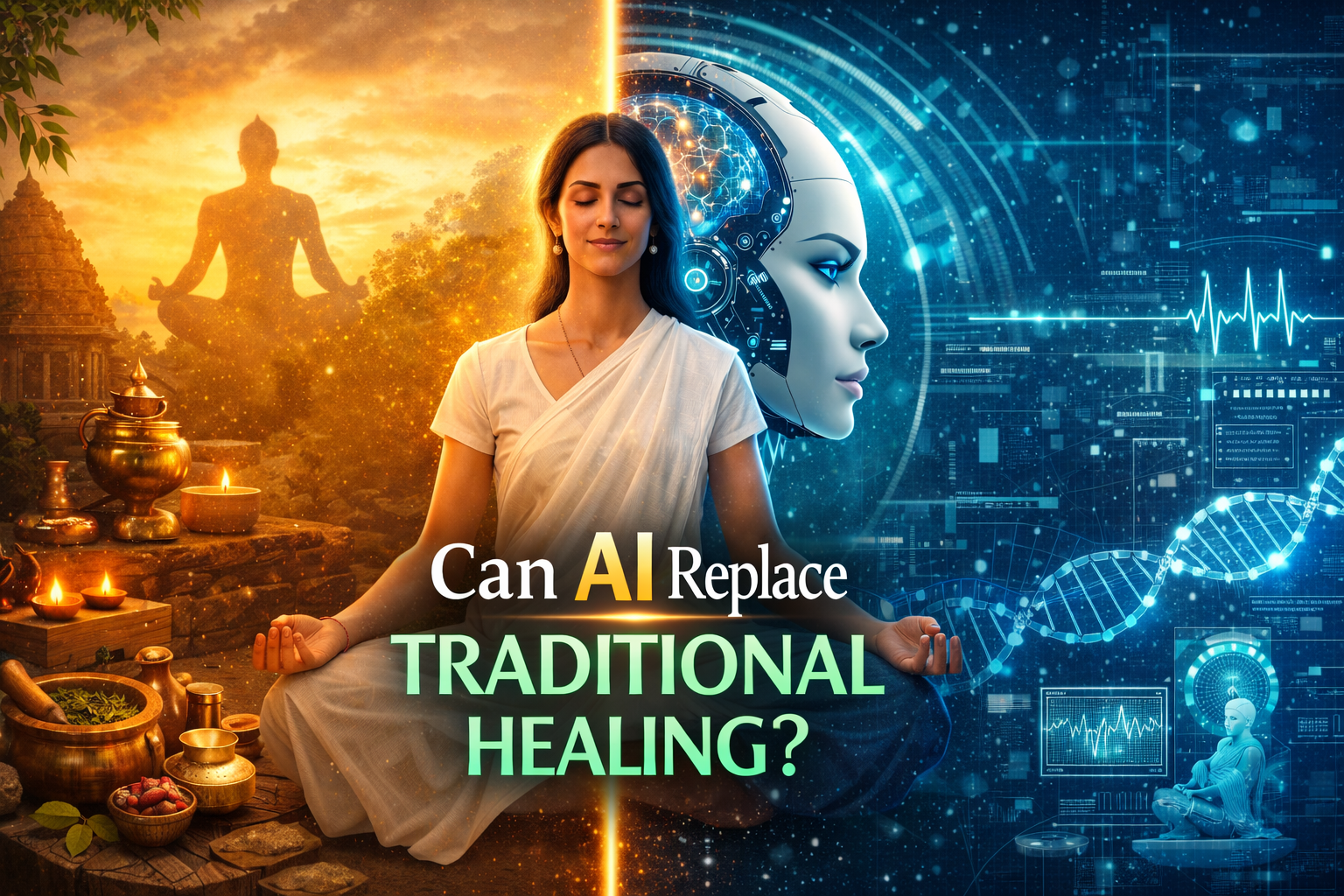
Traditional healing has survived for thousands of years, rooted in nature, intuition, and human connection. AI, on the other hand, thrives on data, algorithms, and automation. Rather than viewing them as competitors, the real conversation lies in how AI can support, enhance, and preserve traditional healing—without replacing its soul.
This blog explores the intersection of AI and traditional healing, answering whether technology can truly replace ancient wisdom—or if the future lies in collaboration.
What Is Traditional Healing?
Traditional healing systems are holistic medical practices developed over centuries, focusing on balancing the body, mind, and spirit.
Key Characteristics of Traditional Healing:
- Personalized treatment based on body constitution (Prakriti)
- Natural therapies using herbs, diet, lifestyle, and detox
- Strong healer–patient relationship
- Focus on root cause, not just symptoms
- Integration of mental, emotional, and spiritual well-being
Popular traditional systems include:
- Ayurveda
- Yoga & Meditation
- Traditional Chinese Medicine (TCM)
- Siddha & Unani
- Indigenous and folk healing practices
These systems emphasize human intuition, observation, and experiential wisdom, which AI alone cannot replicate.
Understanding AI in Healthcare
Artificial Intelligence in healthcare uses machine learning, data analytics, and predictive algorithms to assist in diagnosis, monitoring, and treatment planning.
Current Uses of AI in Wellness & Healthcare:
- Symptom analysis and early disease detection
- Wearable health monitoring
- Personalized diet and fitness plans
- Mental health chatbots
- Predictive analytics for lifestyle diseases
AI excels at processing massive amounts of data quickly and accurately, something human practitioners cannot do alone.
Can AI Replace Traditional Healing? The Honest Answer
No—AI cannot replace traditional healing.
But yes—AI can significantly enhance it.
Traditional healing is deeply human. It involves:
- Touch
- Trust
- Intuition
- Emotional intelligence
- Spiritual awareness
AI lacks consciousness, empathy, and lived experience. It cannot feel a pulse the way an Ayurvedic Vaidya does or sense emotional imbalance during a meditation session.
However, AI can become a powerful supporting tool when used ethically and wisely.
How AI Can Support and Strengthen Traditional Healing
1. Personalized Treatment Planning
AI can analyze:
- Health history
- Lifestyle patterns
- Sleep cycles
- Stress levels
- Dietary habits
This data can help traditional practitioners customize Ayurveda or yoga programs more precisely—without replacing their expertise.
Example:
AI tools can assist in identifying a person’s dominant dosha (Vata, Pitta, Kapha) through lifestyle and biometric data, supporting Ayurvedic assessment.
2. Preserving Ancient Knowledge
Many traditional healing texts are:
- Handwritten
- Fragmented
- At risk of being lost
AI can help by:
- Digitizing ancient manuscripts
- Translating Sanskrit and regional texts
- Organizing herbal databases
- Preserving indigenous knowledge for future generations
This ensures that traditional wisdom is not lost but amplified globally.
3. Improving Accessibility to Healing
Not everyone has access to authentic healers.
AI-powered platforms can:
- Offer guided yoga and meditation
- Provide Ayurvedic lifestyle recommendations
- Educate users about natural healing practices
- Support wellness journeys remotely
This democratizes wellness while encouraging people to seek professional traditional care when needed.
4. Enhancing Preventive Healthcare
Traditional healing focuses heavily on prevention. AI strengthens this by:
- Predicting health risks early
- Tracking subtle changes in sleep, stress, or digestion
- Sending reminders for daily routines (Dinacharya)
Together, AI and traditional healing can shift healthcare from reactive to preventive.
5. Supporting Wellness Retreats & Holistic Centers
AI can help holistic retreats and Ayurveda centers by:
- Designing personalized retreat programs
- Tracking guest progress
- Improving follow-up care after treatments
- Enhancing guest experience without compromising authenticity
This allows practitioners to spend more time healing and less time managing data.
Where AI Falls Short in Traditional Healing
Despite its benefits, AI has limitations:
❌ Lack of Human Intuition
Traditional healing relies on:
- Observation beyond data
- Emotional cues
- Subtle energy awareness
AI cannot perceive these.
❌ No Emotional or Spiritual Intelligence
Healing is not just physical.
AI cannot:
- Build trust like a healer
- Offer compassionate presence
- Guide spiritual transformation
❌ Risk of Over-Standardization
Traditional healing is not one-size-fits-all.
Over-reliance on AI may reduce rich, personalized care into generic recommendations.
The Future: Collaboration, Not Replacement
The future of wellness lies in AI-assisted traditional healing, not AI-dominated healing.
Ideal Balance:
- Traditional healers lead with wisdom
- AI supports with data and efficiency
- Patients receive holistic, personalized care
When technology respects tradition, and tradition embraces innovation, healing becomes more powerful than ever.
Ethical Use of AI in Traditional Healing
For AI to serve traditional systems responsibly, it must:
- Respect cultural integrity
- Avoid replacing practitioners
- Be transparent and non-commercially exploitative
- Protect patient data
- Support authenticity, not dilute it
Conclusion: Can AI Replace Traditional Healing?
AI cannot replace traditional healing—but it can help it evolve, scale, and survive in the modern world.
Traditional healing carries the soul of humanity’s wellness journey. AI brings efficiency, reach, and precision. Together, they can create a future where ancient wisdom and modern intelligence heal the world—side by side.
No. AI can assist but cannot replace the human intuition, experience, and emotional intelligence of traditional healers.
Yes, when used ethically as a support tool—not as a standalone medical authority.
Not if AI is used responsibly to support, not dominate, traditional practices.
No. AI cannot replace traditional healing systems because Ayurveda and yoga rely on human intuition, personalized diagnosis, emotional understanding, and spiritual awareness. AI can support practitioners with data and insights, but the core healing process remains human-centered.
AI helps traditional healing by digitizing ancient texts, supporting personalized wellness plans, tracking lifestyle patterns, and improving preventive care. When used ethically, AI strengthens traditional practices without altering their original principles or authenticity.
Yes. AI-assisted traditional healing is safe when used as a complementary tool under the guidance of qualified practitioners. It enhances monitoring, prevention, and personalization while traditional healers ensure holistic, natural, and balanced care.